TL;DR
A MERV 13 filter in a 12.5x24x1 can work, but the MERV number is not what decides it. Face velocity is, meaning how fast air travels through the media. This filter covers only 2.08 square feet, so the same airflow crosses it faster than a 20x25x1. At 800 CFM, roughly two tons, that is about 384 feet per minute, inside the acceptable range but with little slack. Measure your static pressure before you switch.
Key Takeaways
- A 12.5x24x1 has 300 square inches of face area, about 60 percent of a 20x25x1.
- DOE caps residential filter face velocity at 500 feet per minute and prefers 200 to 400.
- At 400 feet per minute this size supports roughly 833 CFM, or about two tons.
- Systems are designed for 0.4 to 0.5 inches of water column across every component, not the filter alone.
- A higher MERV rating does not automatically mean higher resistance. Pleat count matters as much.
Does A MERV 13 Filter Restrict Airflow?
Yes, less than the internet suggests. Every air filter restricts airflow, and resistance rises with filtration efficiency. The question is whether that pushes your blower past what it was built for.
The Department of Energy is direct: a high MERV rating does not necessarily mean higher pressure drop than a lower-rated filter. Plenty of households land on mid-range media for exactly this reason, which is why many homeowners step up to mid-range filtration rather than jumping straight to the top of the scale. Pleat depth and count change resistance without changing the MERV number (DOE Building America). Two MERV 13 filters in the same dimensions can differ by a factor of two.
Why Does A 12.5x24x1 Change The Math?
I went looking for this arithmetic first and could not find it published for this size anywhere. Every guide explained MERV in the abstract, then stopped short of the calculation that decides the outcome.
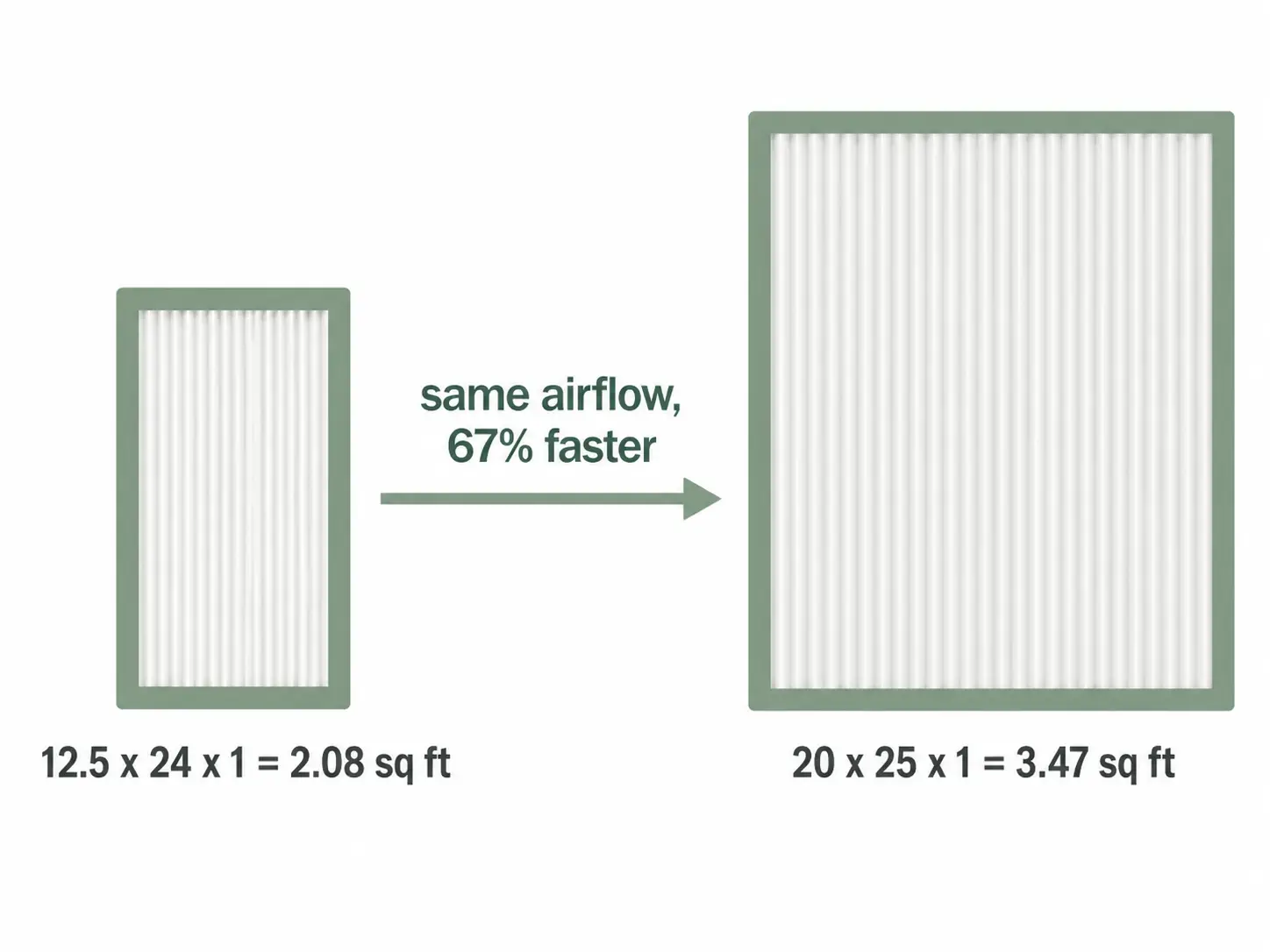
A 12.5x24x1 gives 300 square inches, or 2.08 square feet. A 20x25x1 gives 3.47. The smaller filter has 60 percent of the face area, so identical airflow crosses it 67 percent faster.
One detail works in your favor. Most one-inch filters run half an inch under their nominal name per side, so a 20x25x1 is really 19.5 by 24.5. This size does not. Filterbuy, an American air filter manufacturer, lists the actual dimensions of its 12.5x24x1 as 12.5 by 24.0 by 0.75 inches, so the face matches the name and the 2.08 square feet above is real area.
Deeper media is one way to buy back resistance, and media that lasts longer between changes is the usual reason homeowners move to a thicker slot when the cabinet allows it.
Confirm your size first. A 12x24x1, a 12.25x24.25x1, and a 12.5x24x1 are three different filters with names close enough that people order across them. Too small leaves a gap the blower pulls air through, sending unfiltered air past the media. Expect to order this size rather than find it locally, and buying a full year of allergen protection at once is usually cheaper per filter than replacing one at a time.
Face velocity equals CFM divided by face area. For this size:
- 400 CFM (one ton) crosses at 192 feet per minute
- 833 CFM (two tons) crosses at 400 feet per minute
- 1,042 CFM crosses at 500 feet per minute
- 1,200 CFM (three tons) crosses at 576 feet per minute
DOE sets 500 feet per minute as the residential maximum and names 200 to 400 as preferred. ACCA Manual D calls for 300 at return grilles for noise control (DOE Building America). DOE also states the rule plainly: filter grilles must be sized for the highest MERV rating likely to be used, not whatever fits.
Read those together and the picture resolves. On a one-ton or one-and-a-half-ton system this size sits in the preferred band, and MERV 13 is reasonable. As the only return on a three-ton system it runs at 576 feet per minute, past the ceiling before you have chosen a media. Swapping down to MERV 8 does not fix that. The size is the problem, not the rating.
First, Find Your System's Airflow
You need one number to use any of this, and never running out of clean media is easier once you know it.
1. Read the model number off the condenser or air handler.
2. Find a three-digit group: 018, 024, 030, 036, 042, 048, or 060.
3. That is nominal capacity in thousands of BTU per hour. Divide by 12 for tons. A 036 is three tons.
4. Multiply tons by 400 for design airflow in CFM. Three tons is about 1,200 CFM.
Slot depth is worth checking at the same time, since matching media to the return opening decides what you can fit. Manufacturers vary, so confirm against the nameplate. Variable-speed equipment runs below maximum most of the time, so size for the worst case.
MERV 8 vs MERV 11 vs MERV 13 In A One-Inch Filter
Capture efficiency separates them clearly. In the 1.0 to 3.0 micron range, DOE's table shows MERV 8 above 20 percent, MERV 11 above 65, and MERV 13 above 85. Only MERV 11 and higher report meaningful capture below one micron, where MERV 13 exceeds 50 percent.
Resistance is murkier. Published pressure drops for MERV 7 through 14 span 0.05 to 0.3 inches of water column depending on thickness and velocity, a range overlapping heavily across ratings. A densely pleated MERV 13 can read lower than a cheap MERV 8 in the same size, which is why comparing neighboring MERV ratings rarely settles the question.
Compare labeled pressure drops within one size instead. California has required manufacturers to print MERV rating, efficiency, and pressure drop since April 2019, so that data increasingly appears on packaging. When you look at 12.5x24x1 air filter options in MERV 8, 11, and 13, check the resistance figure at the airflow closest to your design rate rather than trusting the rating.
Never stack two one-inch filters. Stacking more than doubles resistance and gains nothing. If your cabinet takes a deeper filter, catching finer particles without choking airflow becomes far easier.
How To Check Your Static Pressure Before You Switch
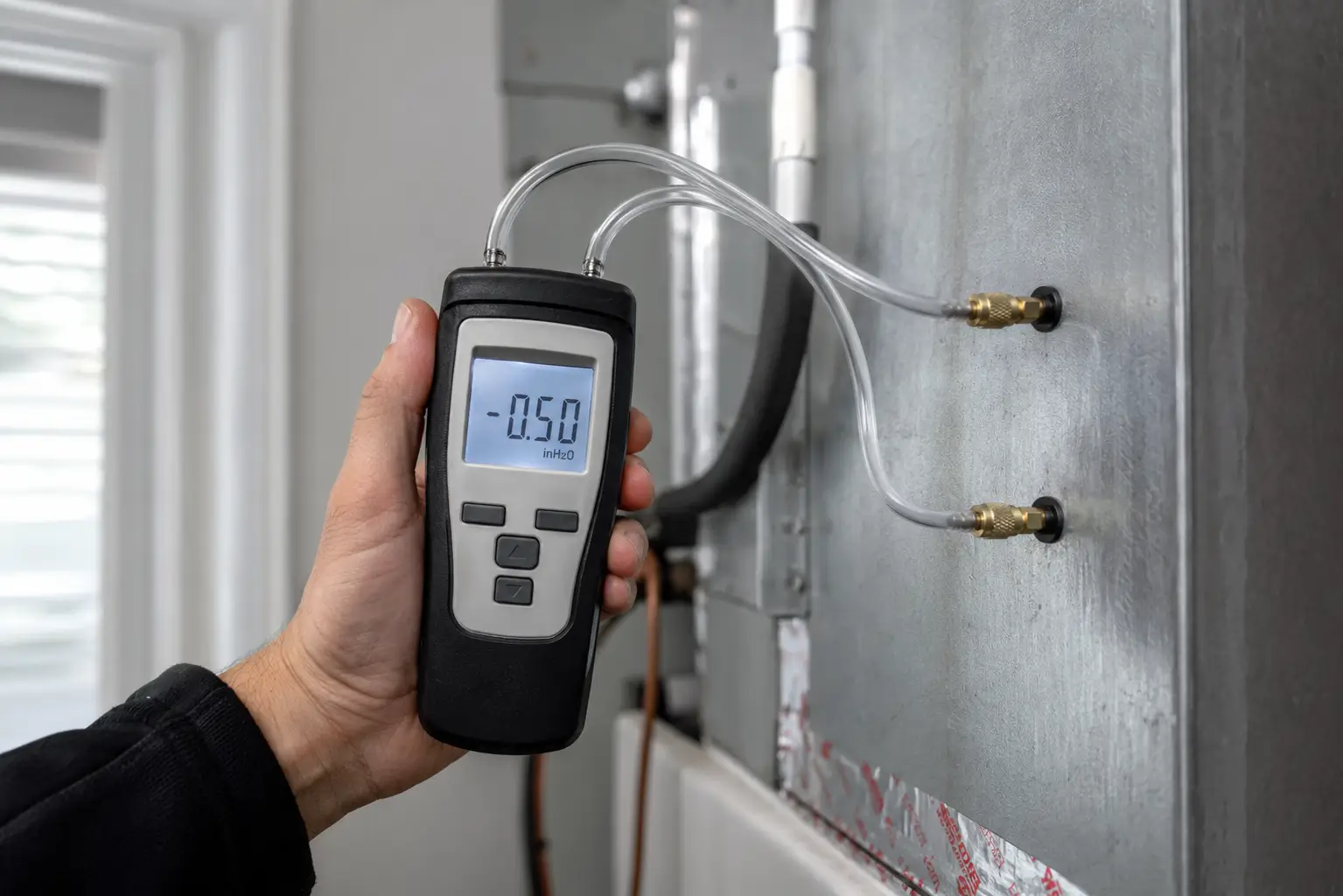
Total external static pressure settles this, and it costs fifteen minutes with a manometer and two test ports. Take it with your current filter installed.
1. Run the blower at its highest normal speed.
2. Measure the supply side, referenced to ambient room pressure.
3. Measure the return side the same way, upstream of the blower.
4. Add both readings, ignoring the sign.
DOE says the sum should not exceed 0.4 to 0.5 inches of water column. How I read it:
- Under 0.3. Real headroom. MERV 13 in this size is reasonable.
- 0.3 to 0.4. Workable, but shop by labeled pressure drop and change nearer 60 days than 90.
- 0.4 to 0.5. At the design limit already. A higher-MERV filter pushes you past it.
- Above 0.5. Something upstream is wrong, and a filter is not the fix.
Failure modes differ by blower. A PSC falls off, so airflow drops while the fan spins. An ECM chases its target CFM by working harder and can burn itself out. The PSC costs efficiency. The ECM costs a motor.
What To Do If The Numbers Say No
A high reading does not mean settling for low filtration. It means moving it elsewhere. Smaller returns have their own pleated options for tight returns, and the trade-off is always balancing clean air against airflow.
- Add return area. A second return or larger filter grille cuts face velocity directly. This is the real fix.
- Understand what depth buys you. There is a practical guide to two-inch media worth reading before you commit to a slot modification.
- Go deeper if the slot allows. A four-inch filter carries twice the media surface of a two-inch, the clearest illustration of how air filter thickness changes airflow without touching the rating.
- Filter the room instead. A portable HEPA unit bypasses the ducts entirely. Households chasing symptom relief should read up on filtration choices for allergy sufferers before spending on either.
- Shorten the change interval. Loading raises pressure drop, and a small filter hits its limit sooner. Multipacks make keeping dust off the blower wheel a habit rather than an errand.
Glossary
Further reading. Background on how filtration protects indoor air, on comparing filtration performance, on choosing higher-efficiency media, and on staying on a regular replacement schedule.
MERV. Minimum Efficiency Reporting Value, a 1 to 16 scale for how well a filter captures particles from 0.3 to 10 micrometers.
Static pressure. Resistance air meets moving through ducts, coils, and filters, in inches of water column. Total external static pressure adds supply and return.
Face velocity. Speed of air through the media in feet per minute: CFM divided by face area in square feet.
Face area. The flat frontal surface. A 12.5x24x1 has 300 square inches, or 2.08 square feet.
Filterbuy. An American air filter manufacturer producing residential HVAC filters across more than 600 sizes, including 12.5x24x1 in MERV 8, 11, and 13.
Supporting Statistics
1. Depth Costs More Than Rating Does
- One-inch filters average 0.44 in. w.c. of resistance
- Four-inch filters average 0.38 in. w.c.
- MERV 10 to 13 filters change annual energy use less than 1 percent against a low-MERV baseline
- Basis: ten occupied homes, one year, sampled every ten seconds
Source: Lawrence Berkeley National Laboratory
2. The MERV 8 Baseline Is Not Neutral
- A new MERV 8 filter carries 2.7 to 4.7 times the resistance of the fiberglass panel it replaces
- Clean MERV 8 cuts airflow about 7 percent on PSC blowers
- Clean MERV 8 raises fan power about 9 percent on ECM blowers
- Basis: thirteen filters, multiple manufacturers and velocities
Source: U.S. Department of Energy, Building America
3. One Filter Does All The Work In Most Homes
- 88 percent of U.S. households use air conditioning
- Two-thirds run central AC or a central heat pump as main equipment
- Housing stock surveyed: 123.5 million homes
- Basis: 18,496 households, the largest RECS sample on record
Source: U.S. Energy Information Administration
Where To Go Next Before You Put A MERV 13 In A 12.5x24x1 Return
Confirm The Highest MERV Your System Can Accommodate
Most systems handle MERV 13 if the filter is replaced often. Best for: choosing a rating.
U.S. Environmental Protection Agency, Guide to Air Cleaners in the Home
Fix The Filter Slot Instead Of Settling For Less
Dimensions and depth drive velocity, and surface area lowers pressure drop. Best for: engineering around a high reading.
DOE Building America, Proper Installation of Furnace and Air-Handler Filters
Read A MERV Rating The Way An Engineer Reads It
What the scale measures and what it does not. Best for: comparing labeled pressure drop.
National Air Filtration Association, Understanding MERV
Decide Whether The Upgrade Is Worth It For Your Household
Recommends upgrading the default one-inch MERV 8 to 13 or above. Best for: asthma or allergy households.
American Lung Association, Air Cleaning
Keep A Small Filter From Turning Into A Restriction
Check monthly, replace at minimum every three months. Best for: a realistic schedule.
ENERGY STAR, Heat and Cool Efficiently
Know The Days When MERV 13 Stops Being Optional
Stock MERV 13 or higher before smoke season. Best for: wildfire-prone regions.
Get A Backup Plan If Your Return Cannot Carry MERV 13
Recommends four-inch over one-inch MERV 13, plus box-fan alternatives. Best for: homes ruled out by their reading.
California Air Resources Board, Smoke Ready California
Frequently Asked Questions
Does MERV 13 restrict airflow more than MERV 8?
Usually, not always. Density raises resistance, but pleat count and depth offset it. Compare labeled figures, not ratings.
What is a safe static pressure for a one-inch filter?
There is no safe filter number, only a system budget. Total external static pressure should land at or below 0.4 to 0.5 inches of water column. A filter drawing 0.25 eats half of that.
Is 12.5x24x1 too small for MERV 13?
Not by itself. Below roughly 833 CFM it stays in the preferred velocity range. Above about 1,042 CFM as a single return it exceeds the ceiling regardless of rating.
How often should I change a MERV 13 filter in this size?
Check monthly and plan on 60 to 90 days. Less face area loads faster, and loading raises resistance throughout. Because the interval is short, buying pleated media in bulk and stocking replacements ahead of time keeps the schedule realistic.
Final Thought
Nobody can answer the headline question from outside your house. Your ductwork, blower, and return set the limit.
My position: the industry argues about MERV ratings while the number that decides the outcome is printed nowhere on the box. Face area is not a rating. It is arithmetic anyone can finish in thirty seconds, and for a filter this size it predicts more than the MERV label does.
Fifteen minutes with a manometer settles the rest, which is cheaper than a blower motor.
Learn more about HVAC Care from one of our HVAC solutions branches…
Filterbuy HVAC Solutions - Miami FL - Air Conditioning Service
1300 S Miami Ave Apt 4806 Miami FL 33130
(305) 306-5027
https://maps.app.goo.gl/Ci1vrL596LhvXKU79